

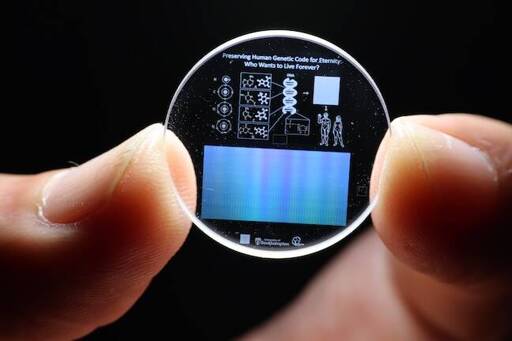
“the medium is silica crystal, similar to optical cable, it’s highly durable. It’s also capacious: The technology can store up to 360 TB of data on a 5-inch glass platter.”
I’ve seen this particular revolutionary technology come by about once a year for the past two decades or so, so let’s say I’m not holding my breath and I will toss this one on the large pile of “bullshit tech articles”
If it is so easy to write to, seems it would be equally easy to erase
Bro has never used a permanent marker
A little bit of rubbing alcohol and it comes right off
Good point. In my lab I’ve used ethanol and acetone as well.
Depends on the surface the marker was used on.
“easy if you have a diffraction-limited watt-scale laser” I guess
Intentional deletion is a lot different to entropy-caused bitrot
prints article out
places it on an overflowing, ancient pile of documents of promising, science proved data storage methods that haven’t made it to public use yet
Nor ever will
I’m up to 45TB of actual used storage. I just want another tape analog. I want inexpensive, slow, long-term storage I can move off-site easily. This paying double to keep disks around and then moving them in boxes is just bad, and online storage is stupid expensive at those sizes.
Was running on Backblaze for years until they screwed around with my client enough that I can’t backup my NAS reliably. I’m not a company, I’m not going to pay the cost of my disks every year to store the content of my disks.
I’ve been considering for a few years standing up a 2u box in colocation.
Open AI just bought out all the glass platter production. Not only will consumers not be able to store their data for 14gy, they won’t have anywhere to set down their drinks either
Sauce? Or sarcasm?
Really?
I been wooshed, sorry v.v
It will not.
For real, what am I going to do when the sun swallows the earth in 4 billion years?
You may be entitled to compensation
@remindme@mstdn.social 14,000,000,000 years
I will remember to check my lemmy inbox right after the earth gets eaten whole by the sun
Remember that CDs, CDRs, and so on were originally pitched as surviving 100 years. Turns out they last a highly variable amount of time but potentially as little as 2-3 years before they degrade, depending on the construction.
So I’ll just say, this is clearly a theoretical value.
Edit: Words.
So it’s 2 to 3 percent of original estimate? That means it’ll last anywhere from 280 to 420 million years. Dead on arrival tech.
How can you be so sure they haven’t already done durability testing??
Because they weren’t invented in 1925? Any durability testing you do today is about assumptions where you accelerate the process for a year by heating it or exposing it to water or whatever will degrade it most to some factor above normal and then extrapolate. That extrapolation was wildly wrong with CDs and it could be with this medium too. Or it might last a lot longer. What they have not done is written to a bunch of them and stored them in a variety of ways for 100 years and concluded they last that long.
Oh, I see the confusion.
I was talking about the new media in the article, not CDs.
So… so are they. The new media has not yet been tested for 100 years because they were not invented 100 years ago
Excellent, I will catalog my journals of my metamorphosis into a giant worm on these.
…but only one million years into it’s life span the human race is gone and aliens are unwittingly melting them down for raw material.
1 million years? You mean 200 top!
Well… I was trying to identify the time that the aliens would come, not that of our demise, but… point taken.
(i.e. “it” was supposed to point to the memory crystal)
That’s the spirit! 👍
I wonder what the read write speed is. Imagine storing your entire movie collection in a crystal the size of a coaster.
Might not be for home consumers anytime soon, article says: “In the next 18 months, the company hopes to have a field-deployable read device that customers can use to read archived data. But SPhotonix isn’t presently targeting the consumer market. Kazansky estimates that the initial cost of the read device will be about $6,000 and the initial cost of the write device will be about $30,000.”
Then goes on to mention they need about 3-4 years of R&D so they can be ready to license the tech
If it’s slow, then it’s the central backup and you use anything else for regular use. Just having it as a fallback for recovery would be huge.
I’ll have a crystal collection that’s actually useful
“This one’s for memory.”
“You actually believe in that garbage?”
“No, you don’t understand…”
How hf can you have 5D space within 3D space? This sounds like marketing bullshit.
The 5D Memory Crystal stores data by using tiny voxels – 3D pixels – in fused silica glass, etched by femtosecond laser pulses. These voxels possess “birefringence,” meaning that their light refraction characteristics vary depending upon the polarization and direction of incoming light.
That difference in light orientation and strength can be read in conjunction with the voxel’s location (x, y, z coordinates), allowing data to be encoded in five dimensional space.
Oh, I get it now. It’s a five-dimensional mathematical space which is given by the three physical space dimensions plus the difference in light orientation and the difference the light strength.
5D is the wrong term, the correct term is multiplex.

It is the correct term if you look at it from a Hilbert space point of view. You have 5 probe options (vector 5D) that give you 5 read options (vector 5D).