
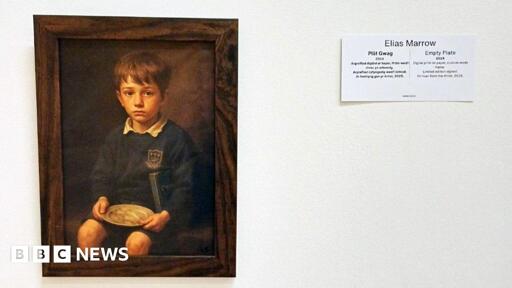
Marrow was interested in “how public institutions decide what’s worth showing, and what happens when something outside that system appears within it”.
He said using artificial intelligence to create it was “part of the natural evolution of artistic tools”, adding he sketched the image before he used AI.
“AI is here to stay, to gatekeep its capability would be against the beliefs I hold dear about art,” he said.
[…]
The artist, who said similar stunts he had carried out at Bristol Museum and Tate Modern were not “approved, sanctioned, or acknowledged”, denied it was vandalism.
“The work isn’t about disruption. It’s about participation without permission,” he said.
“I’m not asking permission, but I’m not causing harm either.”
It’s like the same “logic” AI companies use when they take copyrighted content without permission: claim you’re not causing harm so you don’t need permission. They don’t see the harm, so from their perspective it’s fine, even if the creator doesn’t want them taking their work.
Railing at the institution as being gatekeepers might reveal the flaw in their logic. People or institutions are entitled to decide what belongs in their collection and what does not. Random outsiders are not entitled to be a part of that collection. They can be invited in if the curators are interested in their work, but the curators are generally not required to add them just because they’ve made something. The artist can create their own collection and invite others to be a part of it, but they’re not entitled to be in anyone’s collection. They also can’t just go and take something from someone else’s collection without permission, and even taking a photo of someone else’s work and placing it in their collection would at the very least be bad form. The other artist is just as entitled to decide where they do or don’t want their work displayed.
With encryption and encryption backdoors I often use the illustration that I put a lock on the door of my house, not because I have something to hide, but because I have things valuable to me that I want to protect. Just because I have nothing to hide, it doesn’t mean I give the police a key to my house or let them add their own lock to my door. I wouldn’t want to come home one day and discover a random policeman had let himself in and was making copies of all my documents and photos just to make sure I wasn’t doing something bad. I’d be even more upset if I came home and discovered a policeman from another country had let himself in because he’d gotten a copy of the same key, or a thief was doing the same because he’d gotten a copy of the key.
Building off that illustration, I might have a collection of art in my house. This guy is not entitled to come into my house and look at my art, nor is he entitled to come into my house and put a picture on an empty space on my wall just because he thinks it should be there. Railing against gatekeepers keeping his slop out to me seems as ridiculous as him being mad that I won’t open my door and let him put a picture on my wall. He might not be damaging my walls, but just forcing his way in against my wishes is something I would view as harmful.
Marrow was interested in “how public institutions decide what’s worth showing, and what happens when something outside that system appears within it”.
Wanky pretentious edgelord crap. It’s obvious what happens when you put up a shit AI-generated poster in a museum without permission. Someone asks the staff why there’s a shit AI-generated poster on the wall and they take it down. Other artists have done the “sneaking something into a gallery” thing way better than this many times before.
Sure, Art is supposed to make you think and react. But art that makes you think “wow that guy completely failed at every aspect of this” is of no value. The true scandal isn’t that he did it, it’s that some dumbfuck at the BBC thought it was worth reporting on.
Headline should be: Person sneaks example of vagrant copyright infringement on a scale not previously seen into National Museum Cardiff gallery.
Elias Marrow
Prompt jockey not artist.
I hate the debate over “what is art”. Honestly I think the best answer I could give to the question is “something that was ruined by a bunch of idiots asking ‘what is art’”.
That said, and not wanting to go into that discussion, calling this guy an “artist” seems like a mockery. He’s not an artist, he’s just some idiot with double sided tape.
im not sure i agree.
i’ve heard similar arguments against rap music that it’s not actually music or that producers aren’t musicians if they sample. people always try to diminish new forms by being elitist
I think that art can be defined as a creation that elicits an emotional response. The method of creation has little to do with it.
Whenever digital artists started becoming a thing, they were gatekept as well.
Only with all other art till now most every element is a conscious decision by the artist with intent. Most AI “artists” don’t have a clue what’s actually in their “own” images. Any emotional reaction is a byproduct of the training data (which was created largely by real artists with intent). In which cases the audience would likely understand the history and context of a piece better than the person who typed the prompt. This is nothing at all like other technical developments even though they did indeed see pushback.
Authors/artist intent matters about as much as a warm shit in a shoe when it comes to deciding what is or is not art.
The literal only thing that matters is if the viewer thinks it’s art.
Art is in the eye of the beholder full stop.
The only thing author/artist intent is good for is scholastic endeavours. Valuable and useful in its own right, but the defining aspect of art it is not.
If ai art makes you upset it’s art. People who argue that ai art isn’t art are having an emotional reaction thus it’s art.
i experience an emotional reaction when i step in shit too
Run all the samples through a computer, write a prompt telling it to create music in the style of (x), and keep tweaking the prompt to reiterate the result until something desirable emerges. No skill or understanding of music required, just keep hitting “generate” or whatever until something gets spit out that sounds good.
Vs
Thousands of hours of music making experience, understanding of musical styles, lyric arrangement, composition, heck…even music theory and the ability to read and write musical notes…and take all of that and make something original that, with permission of the original artist, uses modified clips of others’ tracks.
Sampling isn’t the defining difference.
They said they wondered “why such a poor quality AI piece was hanging there without being labelled as AI”
Lol
wow, it seems like it’s printed on printer quality paper. really amplifies how those who use AI for “art” don’t give a flying fuck about art
Would have been far more interesting as an experiment if he had done a better job on better media. Doesn’t usually look so hot, but printing on canvas isn’t some rare thing.
How long would it have stayed up? How would people react?
never mind a canvas, if the guy cared in the slightest about the “art” AI made he’d at least print it on poster paper
this experiment shows how even the “artists” just do not care about those images, and why would they? why would any of us care?
this shows exactly the core of the issue - every piece of art made by a human, no matter how good or bad (whatever that means), is a reflection of the artist. Sometimes they pour their entire soul into a piece, sometimes just a small part of them, but it’s always a reflection of them. So the artist will care about what they’ve made because it’s their own self, in a way. And others will care about it too, because we crave to get to know others, understand them, see the world how they see it - and art allows us to glimpse just that.
AI slop elicits none of those emotions, there is no artist to care about, no reflection of the self, no worldview to glimpse, no way of caring about it, nothing – even if it was you who wrote the prompt, you just can’t bring yourself to give a shit