

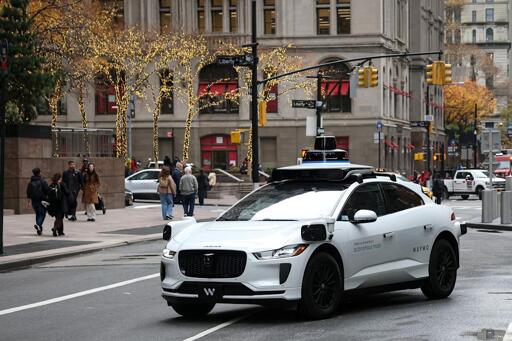
Several of Waymo’s autonomous vehicles were seen stuck in the middle of San Francisco streets following a significant power outage that took out the city’s traffic lights. Waymo responded to the power outage by suspending its ride-hailing services in the city, but images and videos on social media showed the self-driving taxis stopped at intersections with hazard lights on.
“We have temporarily suspended our ride-hailing services in the San Francisco Bay Area due to the widespread power outage,” Suzanne Philion, a spokesperson for Waymo, told Engadget in an email. “Our teams are working diligently and in close coordination with city officials, and we are hopeful to bring our services back online soon.”
Easy. Give police the ability to remotely control driverless cars.
I mean, that is going to be a thing they will implement anyway, and probably not restricted to driverless cars.
If you give police a backdoor to control self-driving cars, somebody is going (to hack it and) use it to kill somebody.
Exactly. Any such remote control would have to be trivial for a cop to use, and also need to directly control only the car(s) the cop is currently interacting with. Think of a situation like this where a traffic light is disabled and a cop is there directing traffic. If driverless cars are approaching from multiple directions then how does the cop direct his commands to only the one he’s focusing on at the given moment? Not all that easy when you think about it…
Like a flashlight, or laser pointer …… or gun. “Just point this gun-like object at the car you want to stop…”. What could go wrong?
Yes! Yes it is! Not even close to as big of a problem as giving police full remote control of our vehicles, but, that too!
You can already kill someone with a car without any hacking.
It happens every day.
OP argued that giving police such powers is a bad idea because there will be NEW vectors for people to harm others — not that other, easier ways don’t exist already.
Then you come in and say, there are ways to kill people using cars already. Literally, the only thing we can say to that is, “yes, we know and what is your point?”
The commenter before me described the solution, give cops an override, as easy. I wanted to highlight that it isn’t that easy. Unintended side effects ought to be considered before coming up with seemingly easy solutions. And this problem is not dissimilar to the one about encrypted chats and law enforcement wanting a backdoor into that. If you build a backdoor, it’s not guaranteed that only the good guys use it. And that raises questions about privacy on the encryption front or questions about abuse, safety, and liability on the self-driving car front.
I’m not arguing any of that. Giving police access to a car override would open up horrible abuse of power but that wasn’t your argument. Your argument was that people would hack it to kill people.
I’m saying that it’s much easier to kill someone by just driving over them with your car and claiming it’s an accident. It happens every day and people walk away without any repercussions. No hacking necessary.
Yes, let’s give the group that has extensive abuse and corruption issues with nigh zero accountability new ways to hurt people.
If anything, we should be advocating against remote vehicle control for the myriad security and safety issues that would introduce.